Note: we’re tracking Annual Reports as they are published. To get a deeper view of the data, book a call or sign up for RHTP Verified Intelligence
In this issue:
CMS holds back the competitive share of Year 2 RHTP awards and keeps the November 30 budget deadline
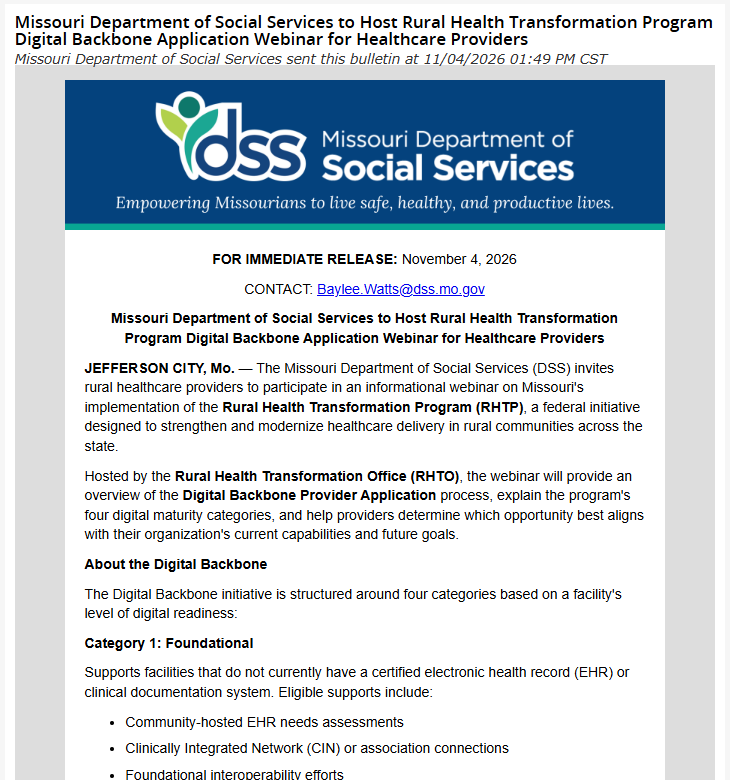
Missouri sets a November 17 webinar on its Digital Backbone Provider Application, now in four maturity categories
Colorado moves its RHTP Advisory Committee to November 16 to weigh in before a November 17 strategic Technical Assistance meeting with vendors
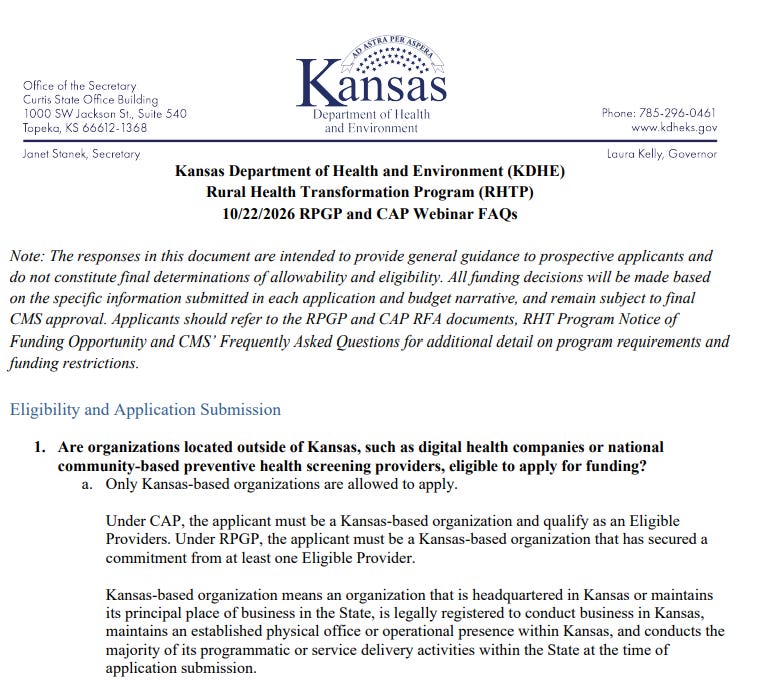
Kansas posts its RPGP and CAP Webinar FAQs: Kansas-based applicants only, and the 20% capital cap is statewide
Rhode Island’s health center association answers 130 questions on its $82,000 Coding Consultant Services – Rural Health Transformation Program (RIHCA-RHTP-RFP-002) and moves proposals to November 13
West Virginia adds a birthing center and a clean-water project to its Released RHTP Awards, now 35 awards
CMS holds back the competitive share of Year 2 RHTP awards and keeps the November 30 budget deadline
We caught the delay on November 3, when Montana DPHHS posted the CMS notice to its program homepage. The October 30 email behind it was reported by Sarah Jane Tribble, Arielle Zionts and Bram Sable-Smith of KFF Health News (Trump Administration Delays Awards Slated To Improve Rural America’s Health). Per their story, the email from Alina Czekai, director of the Office of Rural Health Transformation:
arrived at 4:05 p.m. ET on October 30
says each state’s $100 million Year 2 base funding is available
delays the competitive portion, citing “an additional administrative process requirement,” with no new date
keeps state budget revisions due back to CMS by November 30
The base money is already showing up. Oregon’s program page changed its CMS funding statement overnight from $197,271,577.67 to $297,271,577.67, exactly $100 million more.
Missouri sets a November 17 webinar on its Digital Backbone Provider Application, now in four maturity categories
DSS posted the announcement November 4. The Rural Health Transformation Office will walk providers through the application on Tuesday, November 17, 10:00 to 11:00 a.m. CST, and asks for questions in advance. Registration is on Webex.
Here’s the state’s breakdown:
Category 1: Foundational. Supports facilities that do not currently have a certified electronic health record (EHR) or clinical documentation system. Eligible supports include: Community-hosted EHR needs assessments; Clinically Integrated Network (CIN) or association connections; Foundational interoperability efforts
Category 2: Modernization. Designed for facilities with certified EHR systems that need to strengthen interoperability, cybersecurity, and data governance capabilities to improve secure data sharing.
Category 3: Advanced Technologies. Supports organizations that are ready to adopt innovative solutions, such as: Ambient AI documentation; Remote Patient Monitoring (RPM); Telehealth platforms
Category 4: Digital Innovation. Provides healthcare organizations with the opportunity to propose customized digital health initiatives aligned with the goals of the Rural Health Transformation Program.
No application date or deadline is posted yet.
The July roadshow deck, which we walked July 17, had three categories, with provider-proposed innovation inside Category 3. It now stands alone. Category 1 moved too: in July, “RHTP funds a shared, certified EHR” for a facility with no electronic system. The November list leads with needs assessments.
The baseline is the state’s June Digital Readiness Survey Insights Report: 929 rural facilities responded, 92.4% have an EHR, 71 have none, 31.0% have confirmed FHIR R4 endpoints, and 33.8% connect to a Health Information Exchange.
Accenture works on the Backbone itself; I saw it pitched at NACCHO360 in July in a session Accenture ran with CredibleMind. I haven’t found a published contract for that work. Accenture is also on Colorado’s grantee TA provider list, next item.
Colorado moves its RHTP Advisory Committee to November 16 to weigh in before a November 17 strategic Technical Assistance meeting with vendors
When we covered the Grantee Fact Sheet November 2, both meetings were holding at November 23 and 24. Now the Advisory Committee meets Monday, November 16, 10 to 11:30 a.m. (Zoom), and the Stakeholder Engagement Meeting is Tuesday, November 17, 4 to 5 p.m. (Zoom). HCPF’s reason:
The RHTP AC meeting has been rescheduled to meet before Thanksgiving week and focus our discussion on Technical Assistance (TA). Meeting on November 16 will allow us to incorporate committee feedback prior to our November 17 strategic TA meeting with vendors.
The October 27 stakeholder deck, which we covered October 28, named Colorado’s grantee TA providers: Colorado Rural Health Center, Accenture, CHI/Coral Health, WHA and HTS. Those are the likeliest vendors in the room on the 17th. The AC session is public.
Grantee kickoff meetings run November 12, invitation only.
Kansas posts its RPGP and CAP Webinar FAQs: Kansas-based applicants only, and the 20% capital cap is statewide
We covered the webinar deck October 13. The written answers, dated October 22, went up on the RHTP page overnight. Both RFAs, $44 million for RPGP and $11 million for CAP, are still due November 13 at noon Central.
The first question was whether digital health companies or national screening providers from outside Kansas can apply:
Only Kansas-based organizations are allowed to apply.
The rest that matter to vendors:
Subcontractors and partners don’t need a UEI. Under CAP, subcontractors not yet selected don’t need to be named; the applicant describes scope, cost and selection approach.
Subrecipients follow 2 CFR 200.317 through 200.327: “A hospital may not simply select a contractor of its choice.”
The 20% Category J cap is measured against Kansas’s total Year 2 allocation, not the CAP budget.
Servers, software and implementation costs can qualify if tied to the project. An eMAR system may be allowable. Switch stacks are case-by-case.
Funds go out as advances on documented obligations, and drawn funds can’t be held more than three working days.
Year 1 money must be spent by September 30, 2027; Year 2 by September 30, 2028.
And broadband infrastructure is not allowable. That question comes up in every state, and the answer is always the same.