

Relevant links
2026 Q2 Newsletter Activity Index: state-by state, topic-by-topic deeplinks
Q2 RFP Review / Q3 RFP Watcher: Every procurement from Q2, near-term contracting outlook, and state-by-state analysis
The 50-State RHTP Field Guide: downloadable PDF with RHT personality, program maturity, federal outlays, open procurements, engagement activity, rural geography, and contacts
In this issue:
Pennsylvania adds CEHRT Worksheet
New Mexico posts 8 job openings
Colorado RHTP Advisory Committee Meeting set; office hours updated
Missouri publishes Digital Backbone slides and roadshow updates
Kansas issues Healthworks CVO RFP
Montana launches $4M in Rural EMS grants
Arizona launches AHCCCS Opioid Antagonist Distribution Initiative RFGA
California update: two open grants due August 14
Pennsylvania adds CEHRT Worksheet
This doc popped up this morning and it’s a good reminder that in 10 days the Commonwealth of Pennsylvania will be giving out money to providers based in part on how fast they can send an email.
Application Dates: July 27, 2026, at 8:00 AM to August 14, 2026, at 11:59 AM, or until or until the authorized funding cap has been met, whichever is sooner
Total Available Funding: $25 million
Qualified Entities:
Hospitals
Long-term care nursing facilities
Home health agencies
Behavioral health providers
Community homes for individuals with disabilities or autism
New Mexico posts 8 job openings
Finance Director | Job ID 165059
Operations Manager | Job ID 165060
Data & Evaluation Manager | Job ID 165236
Healthy Horizons Manager | Job ID 165256
Rooted in New Mexico Manager | Job ID 165275
Innovation Fund Grant Analyst | Job ID 165530
Innovation Fund Program Manager | Job ID 165534
Program Manager | Job ID 165574
These roles offer an opportunity to help shape a major statewide effort focused on expanding access, strengthening rural health infrastructure, and supporting healthier communities across New Mexico.
View Open Positions and Apply:
Colorado RHTP Advisory Committee Meeting set; office hours updated
RHTP Advisory Committee Meeting: Monday, July 27, 2026, 10 to 11:30 a.m. Join here.
RHTP Office Hours:
Missouri publishes Digital Backbone slides and roadshow updates
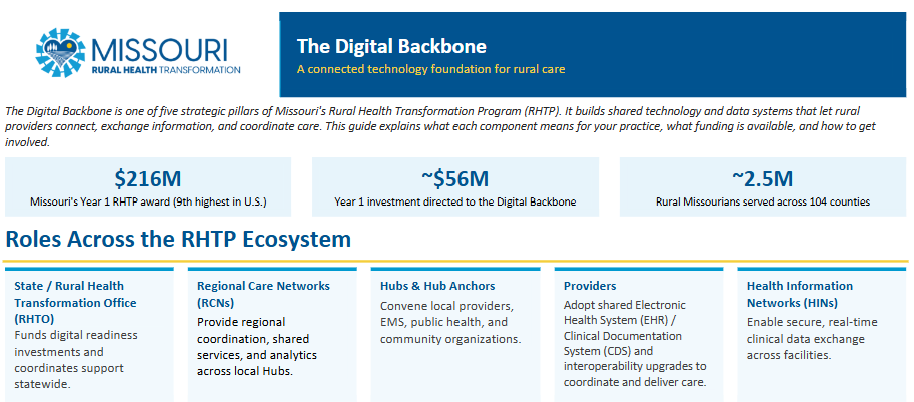
Missouri’s Digital Backbone is the foundational technology and data layer of the state’s Rural Health Transformation Program (RHTP), serving as the “connective tissue” for all other strategic initiatives. Backed by a Year 1 investment of approximately $56 million, the Backbone aims to move rural healthcare from “fragmented silos” to a seamless, interoperable “data highway” that connects hospitals, clinics, EMS, pharmacies, and community organizations.
The Vision: A Paved Highway for Rural Data
The primary goal is to ensure that a patient’s medical records follow them instantly and securely across the healthcare ecosystem. By establishing shared standards like HL7 FHIR R4 and USCDI v3, Missouri is building the Missouri Integrated Health Data Fabric (MOFAB)—a unified source of truth for clinical, claims, and social health data. Core components:
EHR Modernization & Interoperability: Providing a shared, ONC-certified Electronic Health Record (EHR) solution for facilities still on paper, while funding interoperability upgrades for existing systems.
Social Care Referral (SCR) Platform: A statewide tool for “closed-loop” referrals to address non-clinical needs like food, housing, and transportation.
Advanced Technologies: Integrating Ambient AI (to reduce provider documentation burnout), Remote Patient Monitoring (RPM) (particularly for maternal and chronic care), and Telehealth directly into clinical workflows.
Data & AI Governance: Establishing a Digital Governance Board to set statewide standards for privacy, security, and responsible AI use.
The Digital Maturity Framework: A Tiered Approach
To ensure no provider is left behind, Missouri uses an annual Digital Readiness Survey to slot facilities into three maturity categories:
Category 1 (Foundational): Focused on getting the 71 identified paper-based rural facilities onto a shared EHR.
Category 2 (Modernization): Targeting facilities that have an EHR but lack “Required Interoperability” (a FHIR R4 endpoint or HIE connection).
Category 3 (Advanced): Unlocked only after clearing foundational and interoperability checkpoints, allowing for investments in Ambient AI, RPM, and provider-proposed innovations.
Implementation & Sustainability
Year 1 (2026): Establishing baseline metrics through the readiness survey, finalizing data governance, and procuring the statewide SCR platform.
Year 2 (2027): Deploying the shared EHR solution and launching widespread technology implementations.
Year 3 (2028): Integrating social and clinical systems, including the enhancement of the SCR platform.
Years 4–5 (2029–2030): Full standard reporting, advanced dashboards, and achieving statewide, interoperable data sharing as the standard.
Missouri’s plan avoids a “funding cliff” by transitioning the Backbone into a Rural Health Data Trust by 2031. This shared-service model will be sustained through Alternative Payment Models (APMs) that reward improved outcomes and shared savings, allowing providers to pay affordable annual fees for continued access to analytics and interoperability tools. This ensures that once the $216 million initial award ends, the technology and workflows remain in place to support the state’s ~2.5 million rural residents long-term.
