In this issue:
Oklahoma Governor signs RHT legislation
North Dakota publishes scoring tool
Colorado publishes approved project narrative— here’s the diff
Deep dive: West Virginia’s “Health to Prosperity” economic development approach to RHT
Utah forecasts $9.8M in awards across four upcoming opportunities
Vermont is out with an Artifical Intelligence (AI) Transcription/Scribe Technology RFP
Oklahoma Governor signs RHT legislation
Oklahoma HB3066: Signed by Governor Stitt on May 11. The bill creates the Oklahoma Rural Health Transformation Program inside the State Department of Health and stands up a Rural Health Transformation Revolving Fund to manage Oklahoma’s $223,476,948.62 Year 1 RHTP award. It also sets the purpose-and-intent language and rulemaking authority for the Health Care Workforce Training Commission’s role in the state’s RHTP workforce pipeline.
This bill creates a dedicated revolving fund and ties the workforce commission’s authority to RHTP grant parameters rather than treating it as ordinary state appropriations. The bill passed the House 87-5 on March 24 and moved through the Senate without significant opposition. KGOU
Colorado publishes approved project narrative — here’s the diff
The approved budget narrative was posted late last month, but this is the first time we’ve seen the functional narrative.
The most profound difference between the final approved narrative and the earlier drafts is the overall scope and timeframe. While the draft document outlined a broad 5-year, 1 billion dollar strategy, the finalized project narrative narrows its focus exclusively to Budget Period 1, detailing a specific first-year award of 200,105,604 dollars and 17 cents.
As part of this refined focus, the final document enforces strict new spending guardrails that were absent in the draft. For example, it explicitly caps direct provider payments at 15 percent of the total grant funding per period, noting that Budget Period 1 provider payments will actually sit at 11 percent, or 21,524,573 dollars and 22 cents. Additionally, it introduces specific caps on infrastructure spending, limiting Electronic Health Record replacements to a maximum of 5 percent, or 205,280 dollars, under Initiative 5.
In terms of state operations, the final narrative trims administrative overhead while increasing the state workforce capacity. The draft versions projected administrative costs at 2.98 percent of the total allowable funds and requested 18 new Full-Time Equivalent positions at the state level to manage the grant. The finalized narrative lowers that administrative budget cap to 2.65 percent but increases the state staffing request to 19 new Full-Time Equivalent positions to ensure adequate oversight.
Several programmatic guardrails were also added to the final version to comply with federal restrictions, particularly concerning nutrition and workforce development. In the initial drafts, Initiative 1 allowed funding to be used broadly for growing and cooking food, expanding SNAP waivers for purchasing prepared foods, and general food as medicine interventions. The final narrative renames this initiative to Transforming Rural Care: Chronic Disease Prevention, Training, and Management, and adds explicit language stating that no funds will be used to purchase food. Instead, the final version restricts nutrition funding to patient education, healthy food storage supplies, and food bank capacity support. Similarly, while the drafts allowed Initiative 6 funds to cover application and credentialing fees for health workers, the final version explicitly notes that health worker training and professional development is funded excluding credentialing.
Finally, the state altered the terminology it used for its innovative care models. The draft narratives heavily referenced piloting a specific CARPE DIEM framework for rural hospital transformation. In the final approved version, the CARPE DIEM terminology was removed entirely and replaced with a broader emphasis on Whole Person Health and Support for Alternative Care Models.
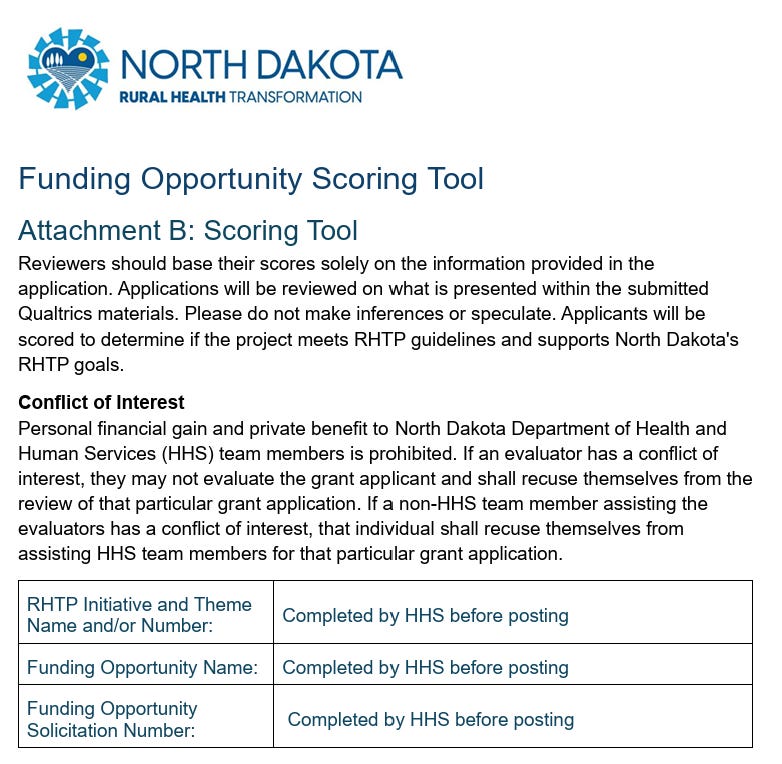
North Dakota publishes scoring tool and FAQ
Always helpful seeing rubrics and what others are asking.