

In this issue
New Hampshire: GO-NORTH HUB Foundation for Healthy Communities (FHC) hosts School Based Oral Health Informational Session
North Dakota posts an FAQ for its $22 million Rural Ambulance Modernization opportunity: Remounts welcome
Maryland fileds questions for its Pathways to Health Careers and RISE workforce RFAs: five-year service commitment clawback is rough
Maine picks 11 rural hospitals to share $30 million from its Rural Hospital Efficiency Fund for planning
West Virginia doubles the ceiling on its Design and Administer Statewide, Multi-Payer Payment Models AFA to $5 million
Kansas opens the Dementia-Related Behavioral Supports in Rural Nursing Facilities Pilot RFA
Ohio RHT Deep Dive: Systemic Integration Over Cash Injection
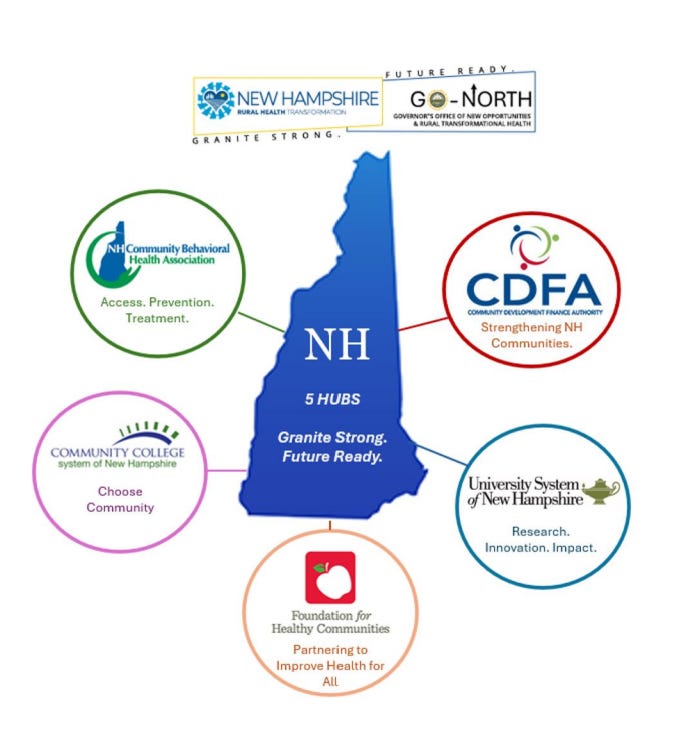
New Hampshire: GO-NORTH HUB Foundation for Healthy Communities (FHC) hosts School Based Oral Health Informational Session
The Foundation for Healthy Communities GO-NORTH School-Based Oral Health Information Session on Monday, August 24th from 10:30 AM - 11:30 AM, REGISTER HERE. Learn more about the eligibility criteria, award requirements, and receive guidance about this Request for Application that supports expanding access to preventative oral health services in rural areas through investments in School-Based Oral Health programs, including expansion of existing programs, starting new programs, and the adoption of electronic dental records systems to support the long-term sustainability of School-Based Oral Health programs throughout New Hampshire. For any questions, reach out to RHTP-FHC@healthynh.org.
Maryland fileds questions for its Pathways to Health Careers and RISE workforce RFAs: five-year service commitment clawback is rough
Maryland’s Department of Labor published a public Q&A for the two RHTP workforce solicitations it runs out of its Division of Workforce Development and Adult Learning — Pathways to Health Careers and Rural Incentives for Strengthening Employment in Healthcare (RISE), both released July 10 — ahead of an August 9 application deadline that closes at 11:59 p.m.
There are more than a hundred questions, spread across general mechanics, allowable uses, the service commitment, and each program. And the questions come from everywhere — training providers, out-of-state education partners, small healthcare-training businesses, universities, worker-owned cooperatives, even vendors building AI telehealth simulations. New organizations are eligible with no operating-history requirement, training providers can lead, there’s no minimum number of trainees, and a private practice can be both lead applicant and the employing rural provider. This is a wide-open, non-insider field, and the volume of eligibility probing is the proof.
The five-year rural service commitment, and the clawback behind it, was the source of a lot of questions. Any participant who receives direct financial support or training that leads to a credential in a clinical occupation must sign a contract committing to five years of work in a wholly-rural Maryland jurisdiction, and if they don’t finish it, the grantee has to return funds to the state on a pro-rated basis. The grantee owns the tracking for all five years — collecting names and contact information, monitoring fulfillment, chasing a participant who moves out of state at year three — even though the money itself is a one-year grant.
MD Labor was asked directly whether it would help track participants by social security number and said no; it also said it does not anticipate awards that fund the tracking past a single year, so applicants should build one budget year of tracking cost and absorb the rest. There is no age exemption, either: a high-school student who earns a CNA credential on RHTP funds triggers the commitment, though CMS recommends states avoid pushing direct licensure incentives at the high-school level in the first place. Non-clinical roles — community health workers, certified peer recovery specialists, direct support professionals, healthcare administrative and IT roles — are generally exempt.
Two answers point straight at the vendors and technology firms in this newsletter’s audience. MD Labor was asked whether recurring technology-platform costs for participant tracking, LMS-based training delivery, and care coordination count as administrative overhead against that 10% cap, and it said no — those are direct program costs when they support patient-facing care coordination, participant tracking, or clinical and LMS training. It was also asked whether building AI-supported telehealth training and simulation agents would be disallowed as prohibited research and development, and it said no — that’s allowable training infrastructure as long as it’s deployed for immediate workforce education rather than academic experimentation. That a state procurement Q&A is now fielding and clearing AI-simulation questions is its own signal. And for vendors who haven’t been pulled into a hospital’s application yet, there’s a concrete door: the Maryland Department of Health has stood up a Maryland Rural Health Vendor Directory, and firms can request a listing through a public form so applicants can find them.
The takeaway for anyone weighing a bid is that Maryland is offering one year of money against a five-year, clawback-backed obligation that the grantee has to administer on its own dime after the grant closes. That reshapes the question from “can we run the program” to “can we carry the tracking liability” — and in a field this wide, the applicants who price that honestly are the ones who should win.
North Dakota posts an FAQ for its $22 million Rural Ambulance Modernization opportunity: Remounts welcome
North Dakota HHS posted a Frequently Asked Questions document on August 3 for its Rural Ambulance Modernization opportunity — the roughly $22 million, 110-award ambulance line inside the $50.5 million wave the state announced in late July, with applications closing August 9. It’s a short document, but it draws lines sharp enough to change who should bother applying and what they can spend the money on.
The first line is eligibility. This is a ground-ambulance program, full stop: eligible applicants are licensed North Dakota ground ambulance service providers and ambulance districts, and the FAQ explicitly rules out air ambulance and quick-response units. City, county, and ambulance-district applicants do not need to register with the Secretary of State, and where a hospital or district contracts out the service, the applicant should be the legal entity actually responsible for delivering care — funds flow to that applicant, not to the ambulance tax district, and the application should use the service provider’s data.
The second line is what the money buys, and it’s the one vendors need to read twice. You cannot buy a new ambulance with this funding. The FAQ states plainly that the purchase of a new ambulance or other vehicle is not allowable — the money is to modernize existing rigs through eligible equipment. Radios are in (SIRN-capable, and either handheld or rig-mounted qualifies, as long as the application describes the type and how it supports the modernization plan), but for any equipment item of $10,000 or more, applicants have to complete a lease-versus-purchase comparison. And there’s a hard delivery cliff: all equipment must be fully delivered, and all funds expended, by August 31, 2027. On a grant that pays by reimbursement, a vendor with a long lead time on radios or a power-load system is a real schedule risk, not a footnote.
The third line is the one worth flagging for anyone who thinks of an equipment grant as strings-free: the five-year service commitment reaches even volunteer ambulance services. North Dakota is attaching a multi-year obligation to continue providing rural ambulance service to what is, on its face, a hardware purchase — so the real ask is a five-year operating commitment backed by state money for the gear, not a one-time equipment giveaway. For aftermarket ambulance-equipment vendors who can actually deliver inside the window, the buyers are named and the list is long; for anyone hoping to sell a chassis, this door was never open.
Maine picks 11 rural hospitals to share $30 million from its Rural Hospital Efficiency Fund for planning
Maine DHHS, working with the state’s Office of Affordable Health Care, selected 11 rural hospitals to share $30 million in Rural Health Transformation Program funds aimed squarely at their balance sheets. The award, announced July 31, runs under the state’s Sustainable Rural Health Ecosystems initiative and its Rural Hospital Efficiency Fund, and the point of it is financial survival: the money pays for technical assistance and strategy development to help these hospitals improve long-term efficiency, stability, and sustainability, not for buildings or equipment.
The eleven are Cary Medical Center, MaineHealth Franklin Hospital, Houlton Regional Hospital, MaineGeneral Medical Center’s Alfond Center for Health, Millinocket Regional Hospital, Mount Desert Island Hospital, Northern Light A.R. Gould Hospital, Northern Light C.A. Dean Hospital, Northern Maine Medical Center, MaineHealth Pen Bay Hospital, and Penobscot Valley Hospital.
Selected hospitals must submit their sustainability plans to the state by January, and the resulting projects must be implemented by the following August. In other words, Maine is paying its most financially fragile rural hospitals to first figure out how to stay solvent, then execute.
That framing sits against the backdrop the program was built for: the RHTP is distributing $50 billion to states over five years, positioned as a partial offset to the roughly $137 billion in projected rural Medicaid cuts under the One Big Beautiful Bill Act.
Eleven hospitals now have until January to produce credible financial-turnaround and sustainability plans, and hospitals in this position rarely have the internal capacity to write them alone. That is a concentrated, dated market for financial and operational turnaround advisors, service-line and rightsizing consultants, and the kind of firm that can take a struggling rural hospital from diagnosis to an implementable plan in under six months.
