

In this issue:
Louisiana launches RHTLA.net, a parish-by-parish public data platform for its $208.4M Year 1
Maine’s RHTP Advisory Committee meets again in September, with two meeting decks now in the archive
New York makes the cybersecurity resilience assessment a gate on future RHTP cyber funding, interest form due August 31
Idaho puts open Teams links on nine vendor events running August 24 through September 2
North Dakota closes Technology as an Extender at 49 applicants, and its funding table now totals 770 applications
North Carolina sends applicants to the NC ROOTS Hubs, where Trillium is the only hub with live RFAs
South Dakota announces Rural Health Transformation Technology and Data Grants — 82 grants, $90 million, no recipient named
Louisiana launches RHTLA.net, a parish-by-parish public data platform for its $208.4M Year 1
RHTLA is the first state RHTP site I’ve seen built as a data product rather than a page of PDF links. Four landing sections — Rurality, Needs assessment, Programs, Data & methods — plus an Open Atlas GIS layer.
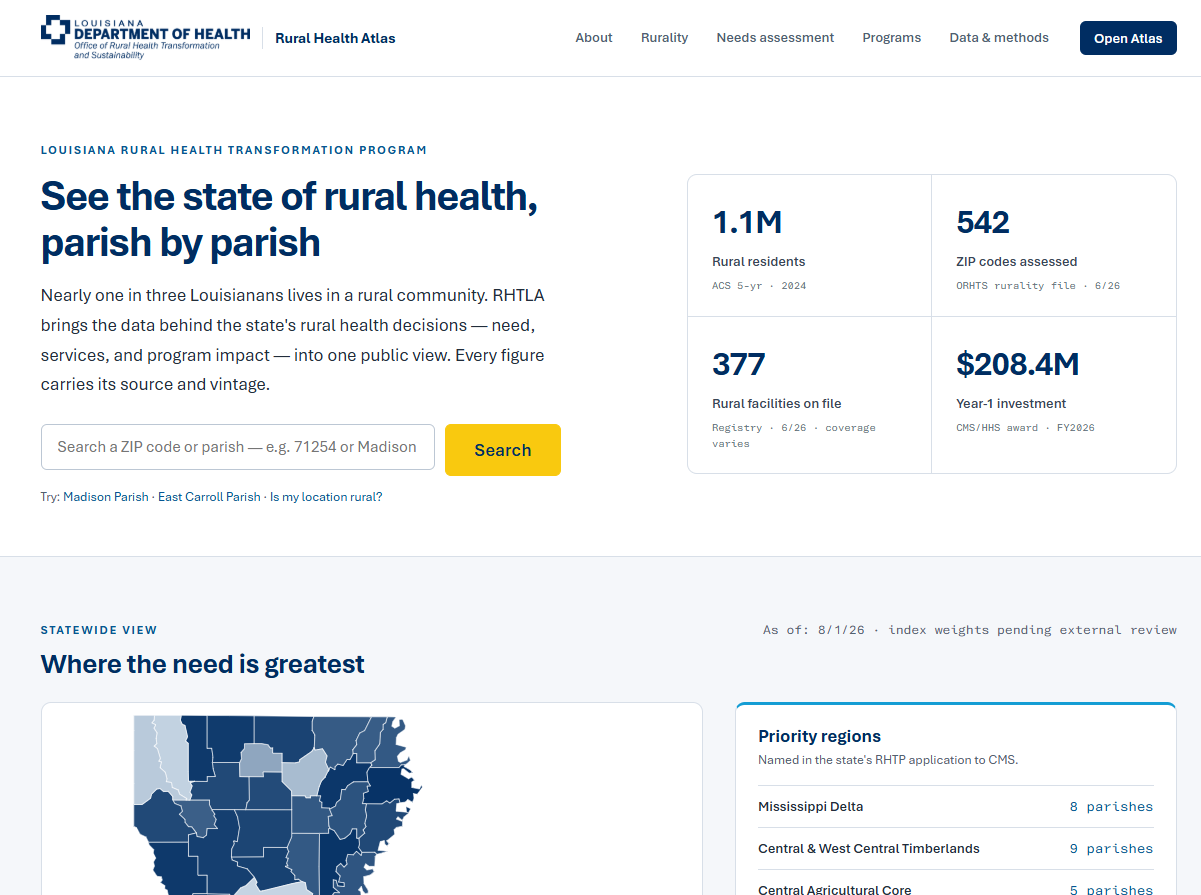
Every headline figure carries its source and vintage inline: 1.1M rural residents (ACS 5-yr, 2024), 542 ZIP codes assessed (ORHTS rurality file, 6/26), 377 rural facilities on file (registry, 6/26, coverage varies).
The methods page publishes the rural accessibility index weights — drive time 30%, social vulnerability 25%, chronic disease 20%, provider supply 15%, broadband 10% — and marks them provisional pending ORHTS sign-off and external academic review. A source inventory names the steward and refresh cadence for each of eight datasets.
Built with three University of Louisiana at Lafayette units: the Center for Applied Artificial Intelligence, the NSF-funded AHeAD Center, and the Louisiana Center for Health Innovation.
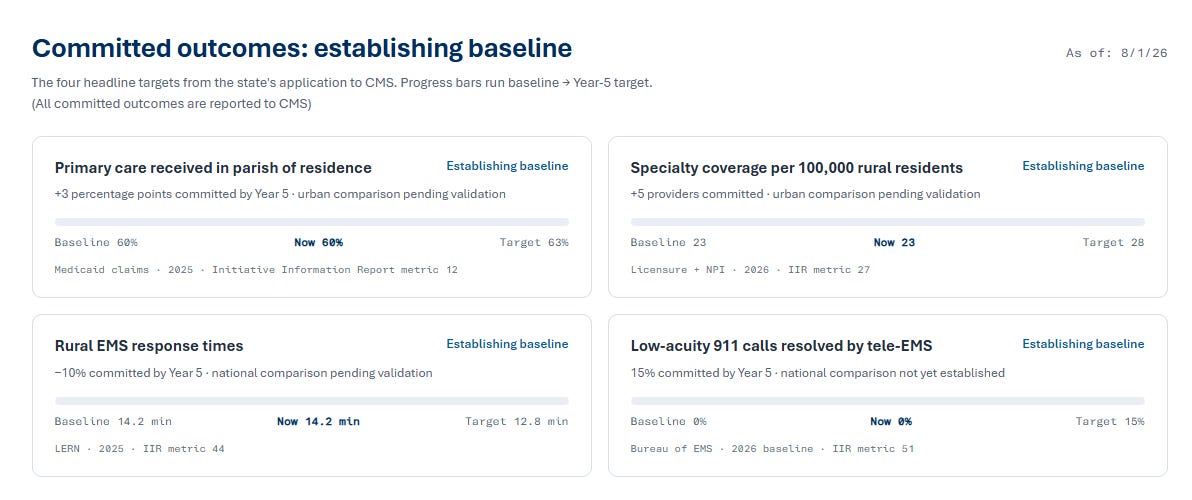
A key component I will be watching is the “Committed outcomes: establishing baseline” section of the Programs page. Every state has to produce this material. Quarterly and annual programmatic reports, fund usage disaggregated by initiative, evidentiary documentation for each completed checkpoint, and quantitative metrics all flow to CMS, and progress reporting began this month.
We are tracking all of these metrics— paid subscribers will get more detail on this in our Q3 Report, due out on October 1.
Maine’s RHTP Advisory Committee meets again in September, with two meeting decks now in the archive
The committee is roughly 30 partners from more than 20 stakeholder groups, convened by Maine DHHS in May 2026 and meeting monthly. Meetings are open to the public in listen-only mode; public comment is not taken. The September date, time and webinar link are still TBD. We’ll be watching for it.
Here’s a rundown of the first two meetings.
July 1, 2026:
Four program-wide metrics named: well-controlled blood pressure in rural areas, 30-day all-cause readmissions, non-financial barriers to care, and financial health of rural hospitals.
Three Year 1 provider funds introduced: $30M for EMR replacement and upgrades, $28.5M for alternative payment model transition, $30M for hospital efficiency.
CMS-approved eligible provider matrix published by fund — acute care hospitals, FQHCs, RHCs, independent rural primary care practices, CCBHCs and OTPs, with eligibility varying by fund.
Hospital efficiency cohort described as “5-10 hospitals at highest risk of financial instability,” criteria still being developed.
August 5, 2026:
Full RHTP staff roster published for the first time: Director Kristen McAuley, Deputy Director Laura Beaumont starting August 31, associate directors for budget and compliance and for data and evaluation, and four of five initiative leads. The Access lead is vacant and interviewing.
Hospital efficiency cohort identified at 11 hospitals, above the earlier 5-10 range, with invitation letters sent and a press release issued.
EMR fund sized: roughly 70 eligible ownership organizations across roughly 330 sites, with rural sites drawing about 50% more than comparable non-rural sites. APM fund: 58 eligible organizations.
Access slide footnotes that two activities in Maine’s original proposal — provider payments for uncompensated care, and for Essential Health Benefits to the uninsured — were not allowed by CMS, and the funds moved to Initiative 5.
Year 1 reporting will cover activities through July 31.
One note for anyone tracking the hospital efficiency work: the August deck exists in two editions. The version exported August 12 attributes the cohort’s technical assistance to “Roux and associated consultants.” The version now posted, exported August 16, reads “consultants who are approved by DHHS and OAHC.” No procurement for that work has been posted.
New York makes the cybersecurity resilience assessment a prerequisite for future funding in Introduction to Initiative 4: Cybersecurity Resilience for Rural NY, with an August 31 interest-form deadline
August 31 is the deadline to submit the Cybersecurity Resilience Interest Form, and the deck says plainly what the form buys:
Completing the cybersecurity resilience assessment is required for facilities seeking future RHTP cybersecurity-related funding consideration. Future funding or support is subject to program eligibility, availability, NYSDOH guidance, and subject to CMS review and approval.
Thirteen slides, a half-hour session on August 17, presented by the Department of Health with no individual named. The webinar is on YouTube. No dollar figure attached to Initiative 4 — the only number in the deck is New York’s $212,058,207.80 Budget Period 1 award. No vendor or product named either; the three services are listed generically as a Cyber Threat Intel Portal, an Incident Response Retainer, and a Cybersecurity Learning Platform, with the assessment tool described only as “an easy-to-use web-based platform.”
The baseline is NIST CSF 2.0 per facility, with HHS Healthcare and Public Health Cybersecurity Performance Goals deferred to Phase 2. Year 1 is rural hospitals only; pharmacies, nursing homes, long-term care and school districts come in Years 2 through 5. Assessments run August through November 2026. The interest form has no URL in the deck — facilities are pointed at rhtpcyber@health.ny.gov.
Also gone from the page: every deadline date. The RCHI extension line that read “The Application deadline for RCHI has been extended to Tuesday, July 14, 2026” was removed yesterday and nothing replaced it.
Idaho posts and passcodes nine vendor events, running August 24 through September 2
Healthcare Infrastructure Support — webinar noon–1 p.m. MDT Aug. 24. Join · Meeting ID 272 420 885 383 370 · Passcode ew367RN2
Crisis Intervention Training — vendor workshop 2–3 p.m. MDT Aug. 25. Join · Meeting ID 287 862 030 303 888 · Passcode ae6S4HN7
Chronic Disease Prevention and Cancer Screening — vendor webinar 10–11 a.m. MDT Aug. 26. Join · Meeting ID 242 674 642 429 059 · Passcode 4L5oV7DR
Cognitive Health Workforce Response Network — vendor webinar 11 a.m.–noon MDT Aug. 26. Join · Meeting ID 266 089 279 607 927 · Passcode po3AC9YG
School-Based Family Support Hubs — vendor conference noon–1 p.m. MDT Aug. 26. Join · Meeting ID 256 425 357 365 755 · Passcode Lw6Gz7pk
Idaho Cognitive Care Pathway Network — vendor webinar 2–3 p.m. MDT Aug. 26. Join · Meeting ID 260 951 781 850 574 · Passcode B7bZ62hp
Diabetes Prevention and Management — vendor webinar 3–4 p.m. MDT Aug. 26. Join · Meeting ID 264 991 258 218 371 · Passcode NZ7RE3FS
Healthcare Infrastructure Support — second webinar noon–1 p.m. MDT Aug. 31. Join · Meeting ID 241 290 629 349 421 · Passcode DV7mB3U9
Statewide Chronic Disease Education Network — vendor conference 11 a.m.–noon MDT Sept. 2. Join · Meeting ID 249 933 389 363 796 · Passcode vt2pa2Rt
Healthcare Career Advancement, the $12.52 million State Board of Education solicitation, still has no event on the calendar. Questions on it are due August 31.
North Dakota closes Technology as an Extender at 49 applicants, and its funding table now totals 770 applications across 23 closed opportunities
Technology as an Extender flipped from “Apply Now” to “Closed (49 Applicants)” yesterday. It is about $5 million with an estimated 20 awards averaging $250,000, which puts roughly two and a half applicants on every award.
Two opportunities are still open — Non-Emergency Medical Transportation Acquisition and Coordinating and Connecting Care — and both sit under Bringing High-Quality Care Closer to Home.
Demand runs several times the money wherever a state discloses it. South Dakota took 144 applications requesting $336 million against $90 million available, below.
