

In this issue
Wisconsin closes the Rural Dental Efficiency and Access grant
California stands up its subrecipient machinery
Texas opens award negotiations on three Rural Texas Strong initiatives
Pennsylvania maps its entire RHTP pipeline
Mississippi’s WEI Q&A reveals who’s circling the $16.8M
Utah extends its LIFT telehealth RFA to August 10
New Mexico revises the Rural Health Innovation Fund schedule
Maine opens a $500K rural-workforce opportunity
North Dakota out with Parents Lead Assessment and Train-the-Trainer Curriculum funding opportunity
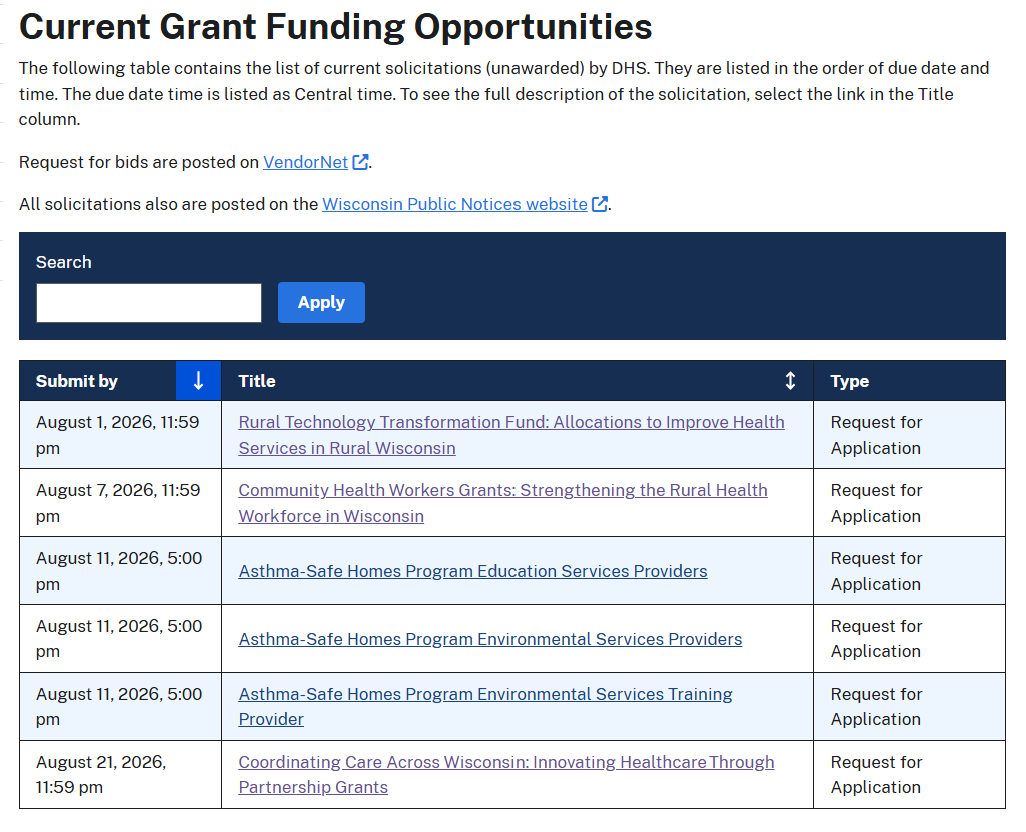
Wisconsin closes the Rural Dental Efficiency and Access grant
Applications were due July 27, and the solicitation has come off the state’s active list.
California stands up its subrecipient machinery
California posted its CalRHT Subrecipient Agreement template and stood up Application Portal and Resources sections on its CalRHT funding page, with FAQs, a Budget Plan, and a Work Plan all marked “coming soon.” It’s the connective tissue a state builds right before its first competitive solicitation goes live — and it landed as CalRHT’s July 27 EHR Modernization webinar wrapped. California hasn’t opened its first RFA yet, but the scaffolding is now up.
Texas opens award negotiations on three Rural Texas Strong initiatives — on a clock
Texas has moved three of its Rural Texas Strong RFAs out of review and into award negotiations, and it is doing so against a stopwatch. In a notice dated July 28, the Health and Human Services Commission (HHSC) told applicants it is preparing to enter negotiations on Initiative 1, Part 2 — Make Rural Texans Healthy Again (HHS0017223), Initiative 4 — The Next Generation of the Small Town Doctor and Team (HHS0017212), and Initiative 6, Part 1 — Infrastructure and Capital Investments for Rural Texas (HHS0017220).
The three RFAs closed in late spring — May 27, June 1, and June 4 — so this is the next gate: HHSC choosing whom it negotiates with. What makes the notice worth reading is the timeline HHSC is imposing to get there.
The compressed timeline
Citing “strict federal deadlines for finalizing and executing the awards and the risk of losing federal funds for Texas,” HHSC laid out a negotiation process measured in business days, not weeks. Once an applicant is notified, it has five business days to answer clarification questions and cure any minor informalities. If revisions are needed, a virtual or phone meeting must happen within five business days of HHSC’s request. The applicant then gets five business days to provide final responses. And when HHSC decides to award, it sends the grant agreement — with just two business days for the applicant to confirm acceptance in writing. At that point the terms are locked: only typographical corrections are allowed, and “any further negotiations to terms at this point are prohibited.”
Miss any of those windows, or prove unable or unwilling to meet HHSC’s requests, and the agency “may decline to award funds.” Accepted agreements route through DocuSign for final execution.
For anyone in the applicant pool, the operational message is blunt: staff up now to turn documents around inside a five-business-day clock, and have signatory authority ready to accept an agreement inside two. For everyone watching Texas, it is an early read on which Rural Texas Strong initiatives reach award first — and a template for how a large-allocation state manages the funds-preservation squeeze.
Mississippi‘s WEI Q&A reveals who’s circling the $16.8M — and clawback scaries
Mississippi has posted its full public Q&A for the Workforce Expansion Initiative (WEI), and the answers matter less than the questions. With the application portal open now and closing August 17, 2026 at 5PM CST, the roughly 80 questions the state fielded are a live map of the applicant pool competing for $16.8 million across four funding streams.
The program, in brief
WEI (NOFO reference RHTP-WEI FY2027-001) is a one-year grant with a performance period ending July 31, 2027, structured around four sub-initiatives:
Workforce Recruitment & Sustainable Ecosystem Development
Secondary Education Medical Career Outreach
Earn While You Learn (EWYL)
Preceptor Expansion
A few terms shape every application:
A fifth stream is coming. A standalone Residency Program Expansion Grant focused on graduate medical education is confirmed as forthcoming under a separate opportunity.
A five-year string on every dollar. Every stipend, salary, bonus, and retention dollar carries a mandatory five-year rural Mississippi service commitment, with recapture pursued from the individual and the subrecipient held ultimately liable.
Hard limits. Loan repayment is out, the target-occupation list is exhaustive rather than illustrative, and CMS’s non-compete clause on clinician salary support applies.
Scoring is public. The state has published its application scoring criteria.
Who’s in the room
The Q&A is anonymized, but the questions show the field.
Community and junior colleges are probing CNA, phlebotomy, and allied-health training and CNA-to-LPN and LPN-to-RN ladders
Hospitals and health systems are circling recruitment and retention bonuses
Medicare-certified hospices are testing whether they count as eligible rural providers
Behavioral-health employers want to fund psychologists’ post-doctoral credentials
Coalitions — multiple Critical Access Hospitals, community-college consortia, joint university applications — are asking how to structure a single lead subrecipient
The questions also show non-traditional applicants sizing up WEI — and the state’s answers set the terms. Asked whether an organization based outside Mississippi could serve as the prime applicant, HHSC didn’t say no: any applicant simply has to demonstrate service to rural Mississippi populations to be considered, a point it returned to again and again.
And to recurring questions about recruiting technology and software platforms — candidate databases, dashboards, and the hosting infrastructure behind them — the state declined to pre-assign a funding track or pre-approve the cost category, directing applicants instead to justify each line item in the project narrative and let reviewers weigh it against the initiative’s goals.
The throughline: WEI’s door is open to workforce-tech and out-of-state players, but only for projects built around demonstrable rural-Mississippi workforce outcomes, not around the tool itself.
The clawback is the story
One theme dominates the Q&A above all others: the five-year service commitment and its clawback. Applicant after applicant pressed the same worry — what happens when a grant-funded physician leaves in Year 3, whether repayment is full or prorated across the 60-month clock, whether the obligation follows the individual to a new rural Mississippi employer or stays with the original hospital, and who documents and monitors it all.
The state’s consistent answer — the subrecipient must recapture from the individual and is held responsible for repayment to the State — lands as a real deterrent, and Mississippi all but says so, repeatedly steering applicants toward training-only projects that don’t trigger the commitment.
That tension is the takeaway for the rest of the country: a five-year clawback attached to one-year money is making sophisticated applicants hesitate, and how Mississippi’s award mix ultimately splits between stipend-bearing and commitment-free projects will be worth watching as other states weigh the same design.
