Oregon: 352 vendors raise their hand for the $197.3M Catalyst Award buildout
Connecting with contractors is key to implementation nationwide
Last week the Oregon Health Authority published a vendor interest directory for the Rural Health Transformation Program. The list contains 352 organizations interested in helping out with Oregon’s first-year RHTP allocation of $197.3M.
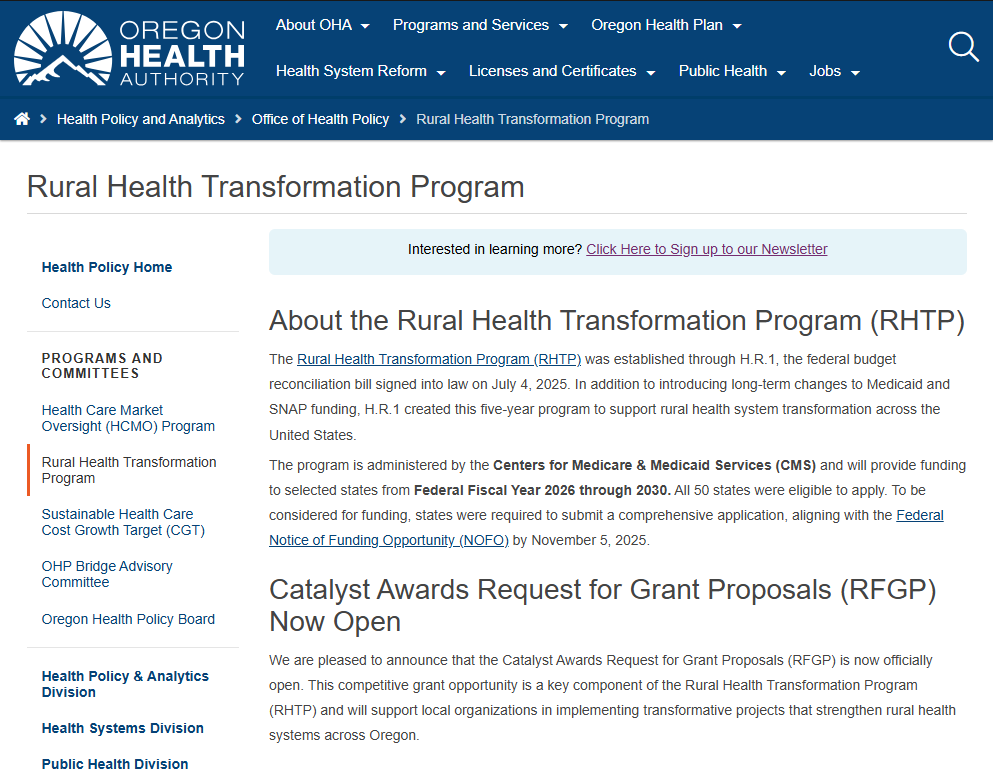
The list is the result of OHA’s open call to vendors willing to partner with the local organizations that will be applying for Catalyst funding, and it’s effectively the first concrete map of who plans to build (or sell) Oregon’s rural-health buildout. Here’s a quick analysis:
Health IT dominates
Of the 352 entries, 135 (38%) classify themselves as Health IT and Data Modernization Partners — easily the largest category, and a useful tell about how vendors expect Oregon to spend the money. Direct Care and Social Service Innovators come in second at 80 (23%), followed by Workforce Training and Educational Entities (43, 12%), Administrative and Grant Management Subcontractors (31, 9%), and Regional Facilitators / “Hub” Organizations (19, 5%). Another 44 (13%) self-categorized as none of the above.
The mix is the story. The directory pulls in national heavyweights — Deloitte, Salesforce, Walgreens, MEDITECH, Teladoc, OCHIN, eClinicalWorks, Welldoc, ECRI, Bamboo Health, Chartis, Guidehouse, Presidio, Hagerty Consulting, Laerdal Medical, IEM International — alongside small Oregon-rooted shops like Creach Consulting (woman-owned, Central Oregon), Stately Pine Consulting, Oregon Erratics LLC (peer-led recovery), 211info (Connect Oregon), Hamilton Health Box, Umpqua Health Newton Creek Clinic, and the COMP-NW osteopathic medical school in Lebanon. Eight .edu institutions and the City of Redmond rounded out the entrants.
What it signals
Oregon’s choice to publish the vendor interest list — rather than hoard it or release only an awarded-vendor roster after the fact — is a notable transparency move. It gives small community-based organizations preparing Catalyst proposals a discoverable bench of potential subs and partners, and it gives outside observers an early-warning indicator of where private-sector capacity is concentrating. Watch the Health IT / Data category in particular: at 38% of the directory, it’s the clearest signal that vendors expect Oregon’s RHTP money to flow toward EHR modernization, telemedicine platforms, AI-assisted workflows, and data infrastructure — not just brick-and-mortar clinical capacity.
Part of the national story
Other states, including New Jersey and Montana, have collected and published vendor information. In the scramble to allocate funds and get programs off the ground, subcontractors and primes are going to have to connect. We are developing data products around this— contact me for more info.
Source: Oregon Health Authority — Rural Health Transformation Program


