In this issue:
Arkansas extendeds HEART
Pennsylvania publishes two FAQs: EHR & HIO participants and FQHCs and FQH
Arizona deep dive: three agencies leading the way
North Dakota opens $22M for Rural Ambulance Modernization and Clinics without Walls: Telehealth Infrastructure
Washington opens its Rural Hospitals (Maternal, Emergency and Specialty Services) RFA
Idaho posts a $1.2M Pediatric Psychiatry Access Line — four bidders qualify
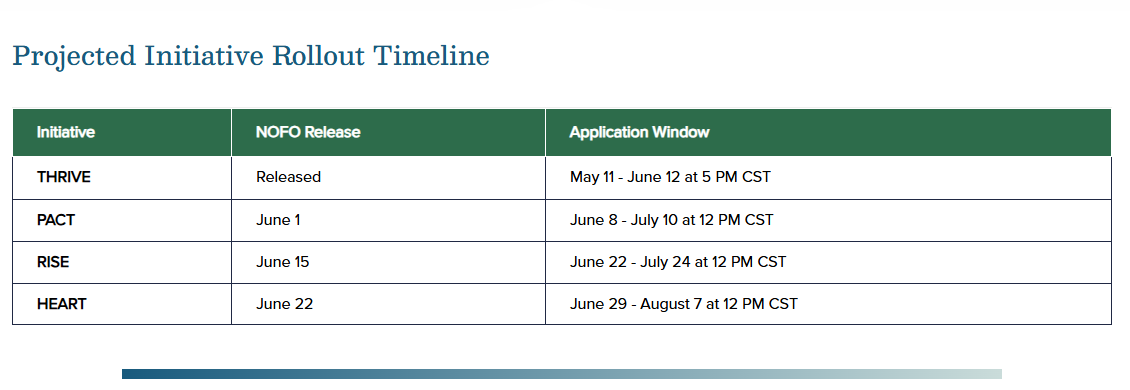
Arkansas extendeds HEART
Healthy Eating, Active Recreation, & Transformation) application window by a week, to August 7 (from July 31).
Pennsylvania publishes two FAQs: EHR & HIO participants and FQHCs and FQH
On July 21–22, 2026, Pennsylvania’s Department of Human Services posted FAQ documents for two parallel Rural Health Transformation Program “Modernizing Healthcare Technology and Enabling Interoperability” payments.
The two programs at a glance
Pennsylvania is running these as non-competitive, first-come-first-served “program payments” under Section 203-H of the Fiscal Code and the Technology and Infrastructure initiative of its federally approved RHTP application — not competitive RFPs. Authorization is by order of receipt, so the practical contest is speed and completeness, not scoring.
The second story is the architecture bet. Pennsylvania is using RHTP dollars to force its fragmented provider base onto a single state-controlled interoperability spine — five certified HIOs feeding one statewide hub (P3N). A connection to a national network (the FAQ names “National E-Health Exchange”) does not satisfy the requirement.
That is a protectionist, closed-loop design choice worth naming: PA is spending federal transformation money to entrench state infrastructure and, by its own language, signaling that hospitals not on a certified HIO “will not qualify for future RHTP Technology and Infrastructure funding.” Onboard now or be locked out of the next round.
FAQ gold: what the questions reveal
Because these FAQs answer questions applicants actually submitted, the questions themselves map the demand side better than any vendor list.
The single most valuable line for our purposes is FQHC Q13: an FQHC (or a consultant on its behalf) asked whether the money can pay a third-party consultant to guide the CEHRT transition and P3N onboarding, and the state said yes — explicitly allowable.
That is a green light in writing that RHTP dollars can flow to advisory and implementation help. It validates the entire premise that there is fundable consulting demand sitting under these procurements, and it is quotable.
The vendor-displacement signals are just as telling. FQHC Q8 and Q9 are someone probing whether they can use the money to move off a generalized CEHRT onto a system “tailored to FQHCs” — the state confirms a generalized-to-FQHC-specific switch counts as “implementing” (allowable), while a plain upgrade does not. Read plainly: FQHCs on general-purpose EHRs are looking to jump to FQHC-specialized platforms, and the state will funded the switch.
FQHC Q16 — “can a National E-Health Exchange connection satisfy the requirement?” — is almost certainly a national interoperability vendor testing whether it can qualify without joining a PA-certified HIO. The answer was a one-word “No.”
On the general side, EHR & HIO Q15–18 are integrators and EHR vendors mapping the edges of “allowable cost” — data migration, interface development, HIO onboarding, P3N connectivity, training, and the recurring question of whether an entity that “already has an agreement but hasn’t started due to lack of funding” can still claim (yes, if they attest funding was the barrier).
Arizona deep dive: three agencies leading the way
The Arizona Center for Rural Health sent an email yesterday chock-full of info, so I thought today would be a good day to catch up with that state’s unique implementation.
On July 10, AHCCCS released the Opioid Antagonist Distribution Initiative RFGA — the first live state solicitation on Arizona’s toolkit. It targets rural counties, Tribal communities, small fire districts, and frontier clinics, and it’s aimed squarely at expanding overdose-response capacity where the safety net is thinnest.
The funded activities are concrete: procurement and distribution of opioid-antagonist kits (naloxone) for first responders, rural clinics, Tribal community health representatives, school nurses, and community members; overdose recognition and response training for volunteer EMS, rural firefighters, and county public health workers; “rural readiness” support such as medication storage and emergency communications; and Tribal partnership support to equip community members and paraprofessional responders with localized overdose-prevention protocols.
One thing to flag: the RFGA’s application deadline isn’t stated on the toolkit card — it routes applicants to a “Visit Grant Application page” link on the AHCCCS RHTP hub. If you’re advising a rural county, Tribal health organization, or fire district, the due date is the first thing to confirm there.
Who’s holding the money: three agencies, one $167M award
Arizona’s award is a single CMS Notice of Award to the Arizona Health Care Cost Containment System (AHCCCS) — RHTCMS332059-01-00, dated December 29, 2025 — with a Year-1 obligation of $166,988,956 and a five-year period of performance running through October 30, 2030. But the Governor’s Office named three lead agencies to administer the priorities, and each owns a distinct slice. That division — detailed in Arizona’s CMS-approved revised Project Narrative (74 pages) and detailed Budget Narrative (78 pages) — is the thing to internalize, because it tells you which agency’s procurement calendar to watch for any given kind of work:
Office of Economic Opportunity (OEO) runs Rural Health Education & Training — 28% of the award, roughly $47M, the single largest slice. This is the workforce money.
Department of Health Services (ADHS) runs two of the Priority Health Initiative Grants: Maternal Health (3%) and Chronic Disease Prevention & Management (7%) — about 10% combined.
AHCCCS runs everything else: Behavioral Health & Substance Use Disorder grants (6%), Making Rural Health Care Accessible (23% — telehealth and digital transformation at 10%, rural-health innovation like mobile care and satellite sites at 13%), and Making Rural Health Resilient (23% — diagnostic equipment, technology and EHR at 18%, shared-services consortiums at 3%, and operational/fiscal technical assistance at 2%).
What’s queued up
The Opioid RFGA is the leading edge, not the whole pipeline. At the Arizona Center for Rural Health’s 52nd Annual Rural Health Conference (June 2–3, Flagstaff), all three lead agencies presented — and OEO and ADHS used their sessions to preview their procurement calendars. OEO’s “Rural Health Transformation: Workforce Overview” walked through a Procurement Opportunities section and an initiative rollout timeline for its workforce program; ADHS’s “Transforming Rural Health: ADHS Highlights” laid out its maternal-health and chronic-disease work; and AHCCCS used its “Advancing Medicaid and Implementing HR1” session to connect the RHTP build-out to the broader Medicaid picture. Read those as advance notice: expect OEO’s workforce solicitations and ADHS’s maternal/chronic-disease grants to follow the opioid RFGA onto the AHCCCS hub, with the bulk of solicitations landing across the back half of 2026.
Engage
AHCCCS is hosting three regional public meetings under a “Share Your Voice on Rural Health” banner — a chance to shape priorities before more solicitations drop (dates are on the AHCCCS hub). Second, AzCRH, as Arizona’s State Office of Rural Health, will write letters of support for organizations applying to rural-focused grants, provided you give them a link to an open funding opportunity — a low-cost credibility boost for any applicant that qualifies.
Northern Arizona Meeting
Date: 7/27/26
Time: 10:30AM-11:30AM
Location: East Flagstaff Community Library. 3000 N Fourth Street, Suite 5 Flagstaff, AZ 86004
In-person attendence: Register for AZ Rural Health Transformation Regional Meetings
Virtual attendence: Register for Nothern AZ Rural Health Transformation Webinar
Central Arizona Meeting
Date: 7/30/26
Time: 1:00PM-2:00PM
Location: Arizona’s Connected Workspace - Room TR-1210. 1400 W Washington St Phoenix, AZ 85007
In-person attendence: Register for AZ Rural Health Transformation Regional Meetings
Virtual attendence: Register for Central AZ Rural Health Transformation Webinar
Southern Arizona Meeting
Date: 7/31/26
Time: 2:00PM-3:00PM
Location: Joel D Valdez Main Library - Tortolita Room. 101 N Stone Ave Tucson, AZ 85701
In-person attendence: Register for AZ Rural Health Transformation Regional Meetings
Virtual attendence: Register for Southern AZ Rural Health Transformation Webinar