

Note: we are eleven weeks out from the October 30 obligation Y1 RHTP deadline, and the sprint is taking shape — first award offers in Maryland, first open RFAs in Virginia, and the first applicant count on a big-dollar close in North Dakota.
For each of these documents— from the RFP to the webinar transcript— we track awards, contracts, and contacts. See the popular Verified Intelligence service to gain access and go deeper.
In this issue:
California posts webinar presentations and recordings for three CalRHT grant programs
Idaho posts a Crisis Intervention Training funding opportunity
Wyoming’s Rural Health Transformation Advisory Committee meets this morning to discuss awards, with no public comment
North Dakota posts applicant counts: 86 for Rural Ambulance Modernization, 3 for Parents Lead
North Dakota opens Coordinating and Connecting Care, $1 million for a single statewide planning award
Virginia opens its first RFAs and publishes the RHT RFA Navigator
Maryland makes $78.6 million in Pillar 2 award offers to 41 organizations
California posts presentations and recordings for the Accelerator Partners, WDRR, and EHR Modernization grant webinars
Workforce Development Recruitment and Retention Grant Webinar | August 4, 2026 | Presentation | Recording Coming Soon
Rural Health Policy Council (RHPC) Meeting #1 | July 28, 2026 | Presentation
Electronic Health Record (EHR) Modernization Grant Webinar | July 27, 2026 | Presentation | Recording
Accelerator Partners Grant Webinar | July 20, 2026 | Presentation | Recording
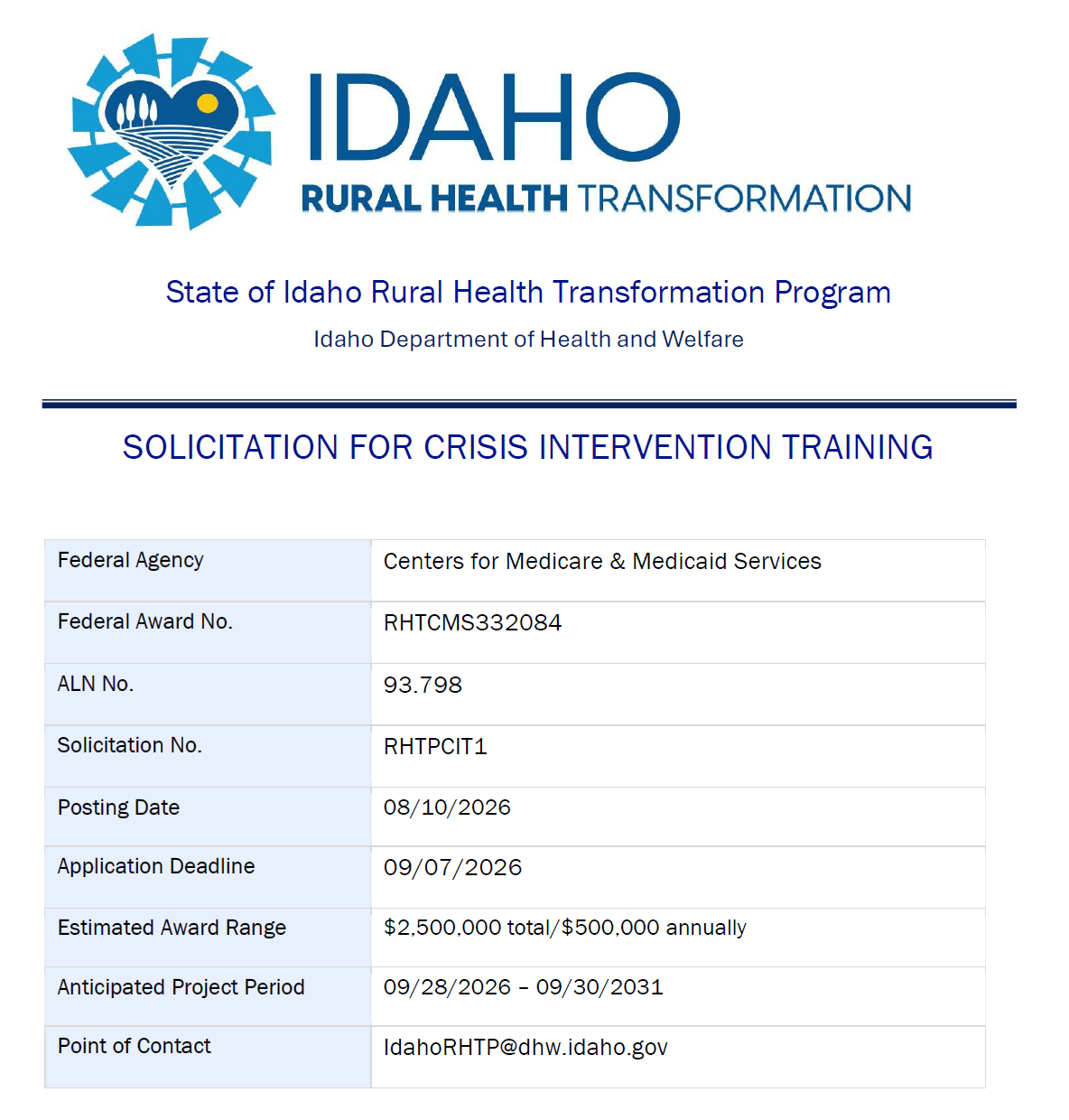
Idaho posts a Crisis Intervention Training funding opportunity— $2.5M, five-year award
The purpose of this subgrant solicitation is to establish and sustain a statewide Crisis Intervention Team (CIT) training infrastructure that expands access to evidence-based crisis response training for law enforcement, emergency medical services (EMS), dispatch personnel, corrections staff, behavioral health professionals, peer specialists, and community partners serving rural and underserved communities throughout Idaho.
Through this funding opportunity, the Idaho Department of Health and Welfare (DHW) seeks to support the development of regional CIT training hubs. The program will increase Idaho’s capacity to respond effectively to behavioral health crises, improve diversion to appropriate behavioral health services, strengthen cross-system collaboration, and reduce unnecessary involvement with emergency departments, jails, and other high-cost systems of care.
Wyoming‘s Rural Health Transformation Advisory Committee meets this morning to discuss awards, with no public comment
Wyoming’s application portal closed at midnight on August 2. Nine days later the committee that decides where the money goes is meeting. From the state’s notice:
The meeting will convene at 8:00 am in the Turntable room of the Thyra Thomson State Office Building at 444 W. Collins Drive, Casper, Wyoming.
At the meeting, the Committee will discuss Rural Health Transformation Fund awards. Members of the public are invited to attend and listen to the proceedings, either in-person or virtually via Google Meet.
Due to the short timeline and need to keep awards impartial, there will not be an opportunity for public comment.
For more information, contact Monique McBride, Chief Policy & Communication Officer: (307) 777-2438 or monique.mcbride@wyo.gov.
North Dakota posts applicant counts, including 86 for Rural Ambulance Modernization
North Dakota closed two opportunities yesterday, with applicant counts:
Rural Ambulance Modernization – Closed (86 Applicants)
Parents Lead: Assessment and Train-the-Trainer Curriculum Development – Closed (3 Applicants).
On the ambulance side, North Dakota planned to fund roughly 110 ambulance grants and got 86 applications. As far as I can tell that is the first RHTP opportunity anywhere that closed undersubscribed against its own award estimate, and it happened on the largest pot the state has put out. The pattern holds from the other direction too: the $300K community gardens money drew 4.5 applicants per award. Demand is thickest where the check is smallest and the eligibility bar is lowest, and thinnest where the money requires a rural ambulance service with the capacity to run a federal grant.
