

In this issue:
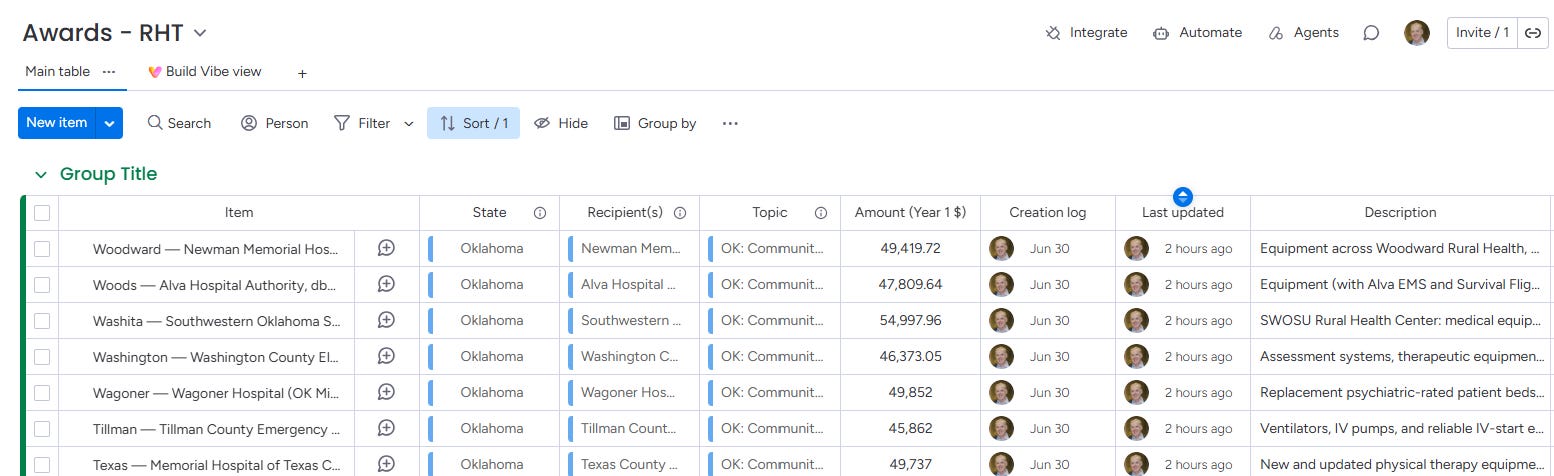
Oklahoma lists winners of Community-Led Wellness Hubs: Microgrants
Arkansas officially opens HEART
Colorado releases fact sheet focused on spending speed
CMS publishes Rural Teach Catalyst Fund Resource Guide
New Mexico opens Rural Health Innovation Fund RFP
Oklahoma lists winners of Community-Led Wellness Hubs: Microgrants
On a programming note: last week we added ~2,500 rural hospitals to our database. This allows us to track RHTP awards and impact with more granularity and the ability to track specific awards across the country.
Arkansas officially opens HEART
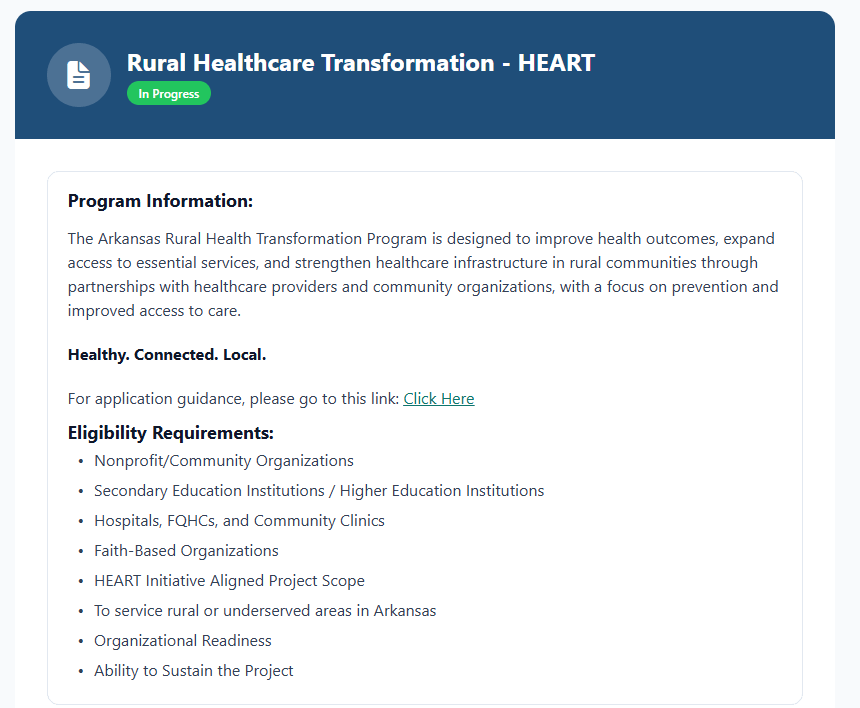
Arkansas — HEART applications open. Arkansas opened its Healthy Eating, Active Recreation, and Transformation (HEART) funding round on June 29, the last of its four RHTP initiative tracks to go live. HEART carries roughly $27.6M in Year 1 (about $151.9M over five years) for community-driven nutrition, physical-activity, and chronic-disease-prevention work in rural counties. Eligible applicants span nonprofits, hospitals and FQHCs, higher-ed, and faith-based organizations; applications are due July 31. With HEART live, all four Arkansas tracks — PACT, THRIVE, RISE AR, and HEART — are now in market, distributing the state’s $209M FY26 award.
Colorado releases fact sheet focused on spending speed
Colorado just published the clearest statement yet of a tension every state in the Rural Health Transformation Program is quietly managing: the money moves on reimbursement, but the providers who need it most can’t float the cash to wait for it.
In a new HCPF fact sheet, Colorado spells out that its default — like most states — is to pay grantees after they’ve spent and documented the money, not before. That is downstream of how CMS structured the program: federal RHTP dollars are drawn down as eligible expenditures are incurred and reported. States aren’t sitting on a pile of cash to hand out; they’re fronting their own money ahead of the federal draw. And if an advance-funded expense is later ruled ineligible, the state eats the loss.
Colorado writes that CMS has signaled expenditure rates are “a significant indicator of program performance and sustainability,” and that failing to obligate and spend on time “may adversely affect future funding availability.”
It’s well-established that RJTP is a use-it-or-lose-it program. The states that can’t get money out the door fast may see their future-year share at risk — which puts every state under pressure to spend quickly, exactly when its undercapitalized rural hospitals, EMS agencies, and Tribal clinics can least afford to wait for reimbursement.
Colorado’s answer is a time-limited fix: the State Controller approved a waiver of Fiscal Rule 3-1, letting the state make case-by-case advance payments through June 30, 2027 — documented need, minimum amount necessary, clawback authority, the works. After that, the blanket waiver goes away. It’s a thoughtful, specific solution to a problem every state shares.
