Note: Everything in RHTP runs against the same clock — CMS requires Year 1 funds obligated by October 30, and Arkansas just showed what a state looks like when it gets there. If you want to know which states are still holding Year 1 money and which have spent it, peep RHTP Verified Intelligence.
In this issue:
Idaho moves the SUD Prevention and Behavioral Health Prevention vendor conferences a day earlier, to 1 p.m. and 2 p.m. MDT September 3
New Mexico announces a Rooted in New Mexico (RiNM) Q&A and an Amendment and posts neither, seven days from close
North Dakota closes Coordinating and Connecting Care, the last of 25 Year 1 opportunities, and the applicant counts now total 793
Arkansas posts its Year 1 RHTP THRIVE and PACT Awards, $149,177,618.45 to 31 organizations across 50 projects
Consider becoming a paid subscriber.
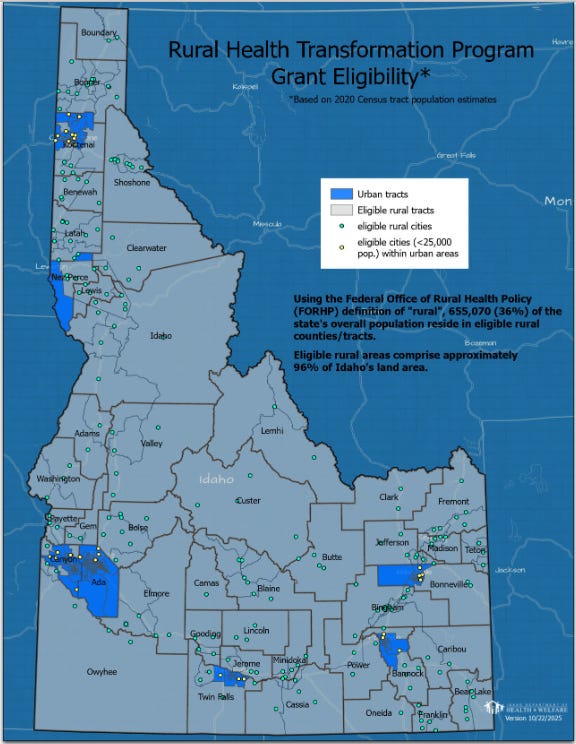
Idaho moves the SUD Prevention and Behavioral Health Prevention vendor conferences and updates rural map
Both solicitations posted August 21 and we covered them on August 24 — $400,000 each, both due September 18. The vendor conferences were set for September 4, SUD Prevention at 11 a.m. to noon and Behavioral Health Prevention at 1 p.m. to 2 p.m. The funding page was updated yesterday and both moved to September 3, SUD Prevention at 1 p.m. to 2 p.m. MDT and Behavioral Health Prevention at 2 p.m. to 3 p.m. MDT, back to back.
The Teams links changed with the times. SUD Prevention is Laserfiche entry 37401; Behavioral Health Prevention is entry 37413. If you calendared the old invitations, they are dead.
Also: Idaho forces a new grain in the geography tracker
Idaho DHW replaced its RHTP eligibility map on August 27, withdrawing the earlier map and city lists as incorrect. The replacement publishes 225 named places in two classes: 196 eligible rural cities, and 29 cities under 25,000 residents that sit inside urban areas and are individually eligible. Eighteen of those 29 had been listed as ineligible in the withdrawn appendix. Three more — Star, Garden City and Hidden Springs — flipped from ineligible to eligible in Ada County alone, a county the old appendix called entirely urban.
Modeling it broke our schema in a useful way. The tracker had a Municipality grain built for New Jersey townships, which are county subdivisions and never cross a county line. Idaho’s are Census places, which do. Star is the proof, and it comes from Idaho’s own withdrawn document: listed as ineligible under Ada and simultaneously eligible under Canyon as “only Canyon Co. annexed parts.” The Census Bureau records Star as spanning both counties. There is no single county it belongs to, so a county-embedded identifier cannot describe it.
Idaho is now on the tracker at a new Place grain keyed to 7-digit Census place codes — 37 records covering the statewide tract rule, the seven partially-urban counties, and all 29 within-urban cities. The remaining 196 are scoped and ready.
One caveat for anyone reading the list as a target list: 31 of the 196 eligible rural cities are unincorporated — census-designated places or, in one case, an Air Force base. They are eligible geography with no municipal government to receive a subgrant.
The withdrawn appendices are still sitting inside solicitation packets that applicants downloaded before the correction. Six Idaho competitions close September 7 and 8.