

In this issue:
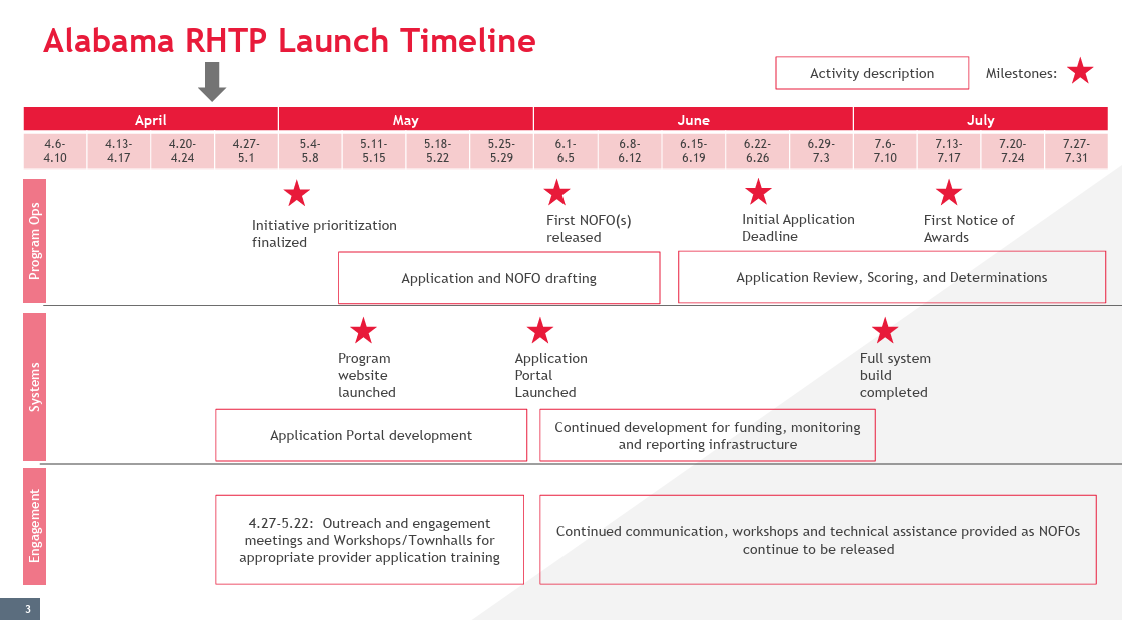
Alabama out with a more detailed launch timeline
Illinois publishes Eligibility Criteria and Rurality Threshold Methodology and Eligible Hospitals
Nebraska launches two new programs
Iowa Kickoff Webinar: Hometown Connections School-Based Services
Iowa published Notice of Intent to Release for Rural Residency Program
Alabama out with a more detailed launch timeline
Illinois publishes Eligibility Criteria and Rurality Threshold Methodology and Eligible Hospitals
Thus is a huge signal from a state that has been very, very quiet. Complete tabular list of all hospitals.
To establish objective eligibility criteria for hospital inclusion in the Hospital Transformation Program’s planning grant opportunity, we assessed the volume of hospital services provided to residents of rural ZIP Codes. The analysis was based on Illinois Department of Public Health (IDPH) hospital discharge and ED discharge data from 2022–2024 and HRSA Federal Office of Rural Health Policy definitions of rural ZIP Codes. Hospitals were categorized as rural or non-rural based on the location based HRSA classification. Similarly, patient discharges and ED visits were categorized as rural or non-rural using each patient’s ZIP Code. The total count and the percentage of each hospital’s discharges and ED visits among rural patients was calculated and averaged across the three years.
Nebraska launches two new programs
Assisted Living Facility (ALF) Special Needs Incentive Payment Program
The Rural Health Transformation Program (RHTP) Assisted Living Facility (ALF) Special Needs Incentive Payment Program supports assisted living providers caring for Medicaid beneficiaries receiving care in an ALF diagnosed with Alzheimer’s disease or related dementias.
The program creates a rate add-on designed to help facilities meet the increased staffing, care coordination, and service demands associated with higher-acuity residents while encouraging residents to remain in their local communities whenever possible.
The program provides enhanced Medicaid reimbursement to eligible ALFs serving higher-acuity residents in rural communities.
Build Rural Workforce
Community Health Workers (CHWs) will work with Local Health Departments (LHDs) and tribal organizations supporting care coordination with rural hospitals or facilities to strengthen prevention and care navigation in rural communities.
Community Health Workers (CHWs) will work with Local Health Departments (LHDs) and tribal organizations supporting care coordination with rural hospitals or facilities to strengthen prevention and care navigation in rural communities. CHWs help connect people with a regular healthcare provider or clinic for ongoing care, support patients in managing chronic diseases by providing education and checking in remotely for non-emergency needs, and coordinate communication between primary care providers, behavioral health specialists, and maternal health services.
Nebraska will develop a formal CHW certification pathway and maintain a statewide registry, defining core competencies and specialized endorsements such as home visiting and lactation support.
Community Paramedicine (CP) will use the medical training of Emergency Medical Services (EMS) providers to support patients with emergency and non-emergency needs. Using telehealth and updated systems, CPs will deliver new “treat-in-place” services, perform chronic disease follow-up, assist with high-risk patient outreach, and connect patients to appropriate levels of care, such as primary care clinics or behavioral health providers.
Rural Health Care Workforce Incentive and Sustainability Model will build Nebraska’s network of SNAP Employment and Training partners in rural areas. Organizations will receive support and training to build infrastructure to become SNAP E&T partners who will provide case management to prepare participants for careers in health care through components like job search training, basic education, vocational training, and job retention to ensure participants can be successful and maintain careers in health care. This will help build the health care workforce as well as create a sustainable, long-term health care workforce pipeline. Rural Nebraskans will be able to become self-sufficient through gainful employment in high-demand health care careers.
Nebraska Rural Health Workforce Incentive Program will offer monetary incentives to health care providers in exchange for a five-year service commitment to work in a rural county. This will support health care professionals in relocating to or continuing to serve in rural communities, thereby strengthening recruitment and retention and expanding clinical services.
Dental Workforce Pipeline will be strengthened by starting student rotations through the UNMC College of Dentistry and Creighton University School of Dentistry. These dental and hygiene students will help rural local health department teams deliver preventive oral health services and gain experience in community public health dentistry. Tribal partners will help co-design prevention services for Native American populations. Outreach programs, utilizing public health hygienists and community health workers, will offer rural portable dental services across the lifespan, including screening, cleanings, fluoride treatments, sealants and proper referrals. Dental Colleges and Free Clinics providing urgent care services and programs offering care to special needs and older adult populations will also be supported.School-Age Health Care Pipeline will introduce school-age students to health care careers through uBEATS and Health Care Heroes League (HCHL).
uBEATS is a web-based platform that introduces students in grades 6 to 12 to health science and behavioral health fields by equipping teachers with modern science, technology, engineering, and math resources. uBEATS will add a new rural health series and launch a Badge and Job-Shadowing Scholarship Program that links digital learning and hands-on experience with rural health care providers.
HCHL is for youth in grades 2 through 5 and focuses on exploring health care careers through hands-on learning, such as mock emergency scenarios. HCHL will be provided in rural and frontier counties and tribal communities.
Rural Virtual Reality (VR) and Skills Acceleration Network will support a statewide, telehealth-enabled simulation network to bridge gaps in education and training, providing access to resources and experiences that are otherwise limited by distance, cost, or availability in rural and frontier settings. Using portable Virtual Reality/Augmented Reality (VR/AR) technology, the network delivers high-acuity, low-occurrence training directly to local providers. Content will include obstetric drills, EMS scenarios, and dental safety modules. Mobile training roadshows, regional hubs, and train-the-trainer cohorts will provide continuous skills transfer and reinforce team-based competency.
Telehealth Crisis Responders for Law Enforcement will ensure all rural and frontier law enforcement agencies have access to mobile crisis providers to support de-escalation and diversion from jail or emergency room levels of care. Law enforcement officers will use a mobile application to have instant, 24/7 access to a trained crisis professional.
Iowa Kickoff Webinar: Hometown Connections School-Based Services
The Iowa Primary Care Association (Iowa PCA) will host a virtual webinar to kick off the new Hometown Connections School-Based services in Iowa, as part of the state’s Rural Health Transformation Program efforts.
This project will help rural health care providers, schools, and local partners leverage schools as trusted locations in rural communities for Iowans to access services. This initiative aims to make it easier for children and families living in rural Iowa to get care close to home. Funding will be invested in healthcare providers to collaborate with schools and other partners to offer more comprehensive and coordinated care including physical, mental/behavioral, and dental health, and other services and supports Iowa children and families need to stay or become healthier. The Iowa PCA will share training, tools, and support to help communities plan this work.
WHO: Open to the general public
WHAT: The webinar will explain Hometown Connections School-Based services, how this project connects to upcoming state funding opportunities, what providers, schools, and partners can expect next, and how rural organizations can stay involved
WHEN: Thursday, May 28th 12:00-1:00pm
For the latest information on the Rural Health Transformation Program, please visit the Iowa PCA website, https://www.iowapca.org/healthyhometownsiowa
