

Lots going for a typically busy Friday— look out for potential data dumps near end of day.
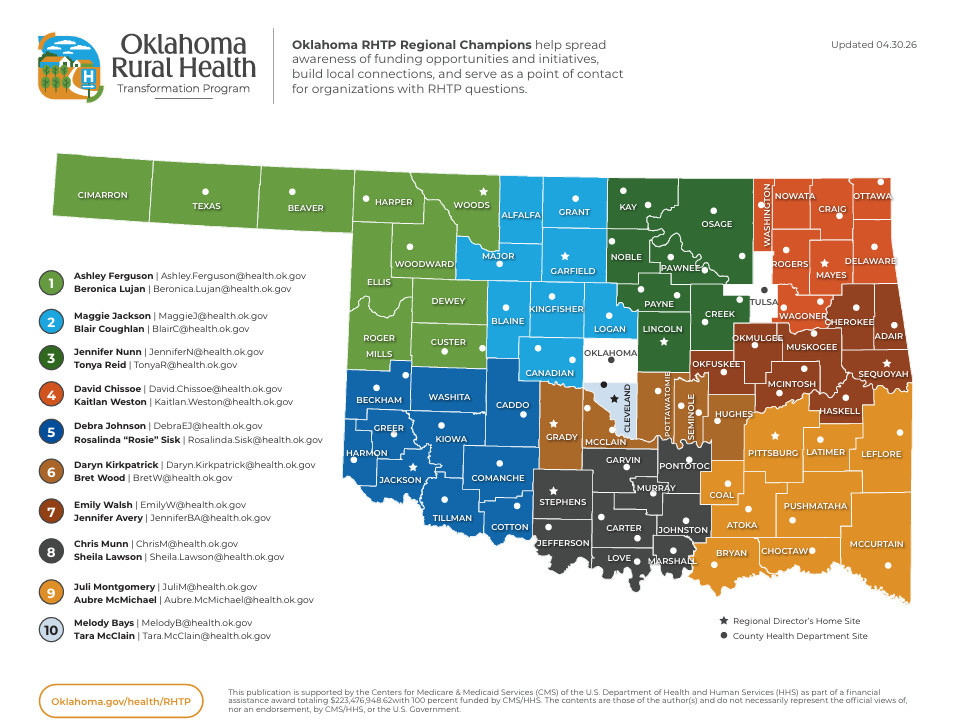
Oklahoma publishes a map of RHTP Regional Champions
Oklahoma RHTP Regional Champions help spread awareness of funding opportunities and initiatives, build local connections, and serve as a point of contact for organizations with RHTP questions.
Legislation Watch
Primary RHT Legislative Actions
One signed bill this week: North Carolina codified its RHTP reporting framework into state law.
North Carolina H696: Governor Josh Stein signed the $319 million Medicaid stabilization bill into law on April 30 as Session Law 2026-1, ending months of program-funding uncertainty. Beyond the immediate Medicaid bailout, Part III of H696 codifies North Carolina’s Rural Health Transformation Plan into state statute — defining the NC RHTP as the plan approved and funded by CMS under section 71401 of Public Law 119-21, and setting a multi-year reporting cadence requiring DHHS to file periodic progress reports to the General Assembly’s specified commission from November 29, 2026 through November 29, 2030. The required components include the total amount of funds allocated to each initiative and the total amount of funds awarded to subrecipients by county. NC Newsline
H696 sits on top of the $213 million CMS award North Carolina received in December 2025, the first of five annual payments expected to total more than $1 billion if the state meets CMS performance benchmarks. RHTP money will flow into a Rural Health Innovation Fund supporting workforce, technology, behavioral health access, and locally governed hubs that link medical, mental health, and social support services. WUNC
The Medicaid portion of the bill drew real friction at signing. Stein flagged provisions creating new Medicaid copays at the federal maximum and a clause that defaults non-citizen Medicaid eligibility to federally required coverage — a change that NC Health and Human Services warned threatens coverage for roughly 26,500 children and 500 pregnant women lawfully residing in the state for less than the five years typically required for federal benefits. WFAE
Stein signed despite those reservations because the alternative was Medicaid running out of money by end of May. SL 2026-1 is now in force; DHHS reporting clock starts running this summer.
Appropriation & Budgetary Links
Five bills this week — four budget vehicles in three states — that carry RHTP funds as line items rather than as their primary subject.
North Carolina H1167, H1146, S915: The House and Senate vehicles for Governor Stein’s $35.24 billion biennial budget proposal, all filed late April 2026 as the short session opened. The Stein budget halts scheduled corporate and individual income tax cuts, includes an 11% average teacher raise plus 2.5% for all state employees in both fiscal years, and provides $319 million to fully fund Medicaid (the same figure that flowed through H696 as a stopgap). WUNC
These bills carry the state-side appropriation authority for the federal RHTP funds North Carolina received — the $213 million for FY2026 plus expected future tranches. Senate leader Phil Berger and Speaker Destin Hall have signaled openness on salary increases but have not committed to Stein’s broader fiscal frame. EdNC S915 has been re-referred to the Committee on Appropriations/Base Budget; H1167 and H1146 are Filed and awaiting committee assignment.
Alaska HB263: The FY2026 operating budget bill, passed by the House 21-19 on April 14 and now headed to the Senate. The bill appropriates roughly $3 billion for Medicaid services with a $33.3 million bump for Medicaid rate increases. Alaska’s $272 million RHTP award — the first of five annual payments expected to total $1.36 billion, the largest federal health investment in state history — requires legislative spending authority to flow to subgrantees, and HB263 plus the related supplemental package are the vehicles that grant it. Alaska Beacon
The clock is unusually tight. Alaska must distribute and obligate the full $272 million by the end of calendar year 2026 or unspent funding is clawed back and redistributed. Alaska Public Media A first Letter of Interest period ran February 17 through March 11 and drew nearly 1,800 submissions; a second LOI window is expected in late summer. HB263 has been reported out with a Senate Committee Substitute, awaiting transmittal.
Michigan SB0878: The FY2026-27 omnibus appropriations bill carrying the full Michigan Department of Health and Human Services budget, passed by one chamber and referred to the second-chamber Appropriations Committee in late April. The MDHHS budget block within SB0878 includes the state-level appropriation framework for Michigan’s $173,128,201 RHTP award from CMS. MHA
Michigan’s House Appropriations Committee took rural-hospital testimony specifically on RHTP fund deployment during deliberations: CEOs from UP Health System, Kalkaska Memorial Health Center, and Munson South Region testified on rural-care access pressures including maternity deserts (22% of Michigan counties), at least 11 labor-and-delivery unit closures since 2010, EMS strain, and behavioral health gaps — pressing for RHTP money targeted to those specific challenges. MHA
SB0878 is now in committee in the second chamber.
South Carolina’s Subrecipient Approach
To distribute its RHT funds, the South Carolina Department of Health and Human Services (SCDHHS) is heavily utilizing a subrecipient grant model. SCDHHS has organized its transformation strategy into five core initiatives: Connections to Care, Leveling Up, Wellness Within Reach, Shoring Up to Sustainability, and the Tech Catalyst Fund. To handle the 10% administrative burden and ensure federal compliance, SCDHHS has contracted with BDO Government Services LLC to conduct quarterly audits, monitor subrecipients, and manage reporting to CMS.
Drilling Down: State RFPs, Spending, and Program Fit
For the first budget period, SCDHHS has released four concurrent Requests for Applications (RFAs/RFPs) corresponding to four of the state’s five initiatives. The fifth initiative, the Tech Catalyst Fund, operates outside this RFA cycle because it is being administered via a third-party partnership with the South Carolina Research Authority (SCRA) to provide non-dilutive seed funding to rural health tech startups.
Here is how the four active RFPs fit into the state’s overall operational and spending plan for Year 1:
1. Connections to Care (SCDHHS-26-001)
Year 1 Funding Pool: $75 million
Program Fit: Aligns with CMS’s “Tech Innovation” goal by expanding digital infrastructure.
RFP Specifics: Applicants must choose one of two tracks. The first is Modernize Health IT Infrastructure, offering $100,000 to $2,000,000 for system modifications, and $5,000,000 to $10,000,000 for complete EHR system replacements. The second track is Expand Remote Patient Monitoring (RPM) & Assistive Technology, which offers $250,000 to $5,000,000 to deploy devices for chronic condition tracking and assistive tech. In compliance with CMS rules, no more than 5% of the state’s total award can go toward replacing an existing HITECH-certified EHR system.
2. Leveling Up (SCDHHS-26-002)
Year 1 Funding Pool: $27 million
Program Fit: Aligns with the CMS goal to “Make Rural America Healthy Again” by expanding proven chronic disease models into underserved areas.
RFP Specifics: This RFP funds Chronic Disease Program Expansion, offering $100,000 to $5,000,000 per award. The state is looking for providers to scale interventions for conditions like diabetes, hypertension, and sickle cell disease. Additionally, SCDHHS is separately procuring a consultant (outside of this RFA) to conduct a statewide rural needs assessment and assist in transitioning the state’s dually eligible Medicare-Medicaid population into integrated managed care.
3. Wellness Within Reach (SCDHHS-26-003)
Year 1 Funding Pool: $27.7 million
Program Fit: Aligns with the CMS “Sustainable Access” goal by removing location-based barriers and bringing care physically into rural zones.
RFP Specifics: Applicants can request $50,000 to $500,000 for Mobile Crisis Response units (e.g., behavioral health mobile teams), or $100,000 to $2,000,000 to Expand Community Care Sites. Funding can cover mobile health vehicles, seasonal pop-up clinics, and health kiosks. The RFP explicitly notes that capital expenditures for these community sites will be strictly monitored so the state does not exceed the federal 20% cap on infrastructure.
4. Shoring Up to Sustainability (SCDHHS-26-004)
Year 1 Funding Pool: $40 million
Program Fit: Aligns with CMS goals for “Workforce Development” and “Innovative Care” by tackling physical infrastructure aging, provider burnout, and business insolvency.
RFP Specifics: This RFP is split into three tracks. Facility Enhancements offers $100,000 to $3,000,000 for non-construction facility upgrades like HVAC and electrical systems. The Masterclass Training Series offers $500,000 to $2,500,000 for larger hospital systems to mentor independent rural providers in risk management and business continuity. Finally, Healthcare Workforce offers direct signing and retention bonuses of $75,000 to $275,000 for physicians, and $37,500 to $62,500 for APRNs and PAs. To comply with federal policy, any workforce subrecipient must legally commit the clinician to five years of rural service, and the funds cannot go to clinicians bound by non-compete clauses.
See below for details pulled from the transcript from the published video of a webinar along with slides for its Rural Health Transformation Program Grant Overview from the South Carolina Office of Rural Health (SCORH).
This video covered the the application details, scoring rubric, and compliance rules discussed apply to all four of the active RFPs administered by SCDHHS (Connections to Care, Leveling Up, Wellness Within Reach, and Shoring Up to Sustainability).
The fifth initiative, the Tech Catalyst Fund, which is being administered separately by the South Carolina Research Authority (SCRA) and is not part of this specific application structure.
